

Kimbap (김밥) are Korean rice rolls: rice and various fillings rolled up in a sheet of dried seaweed. The name says it all: 김 (gim) means seaweed, 밥 (bap) cooked rice. In Japanese, the seaweed sheets are called nori. This recipe makes four rolls, and the amounts follow Korean Bapsang.
What is the difference between kimbap and sushi?
At first glance, kimbap and Japanese maki rolls look similar; the difference is in the rice and the filling. For kimbap, the rice is seasoned with sesame oil and salt, for Japanese norimaki with rice vinegar, sugar and salt. Kimbap is filled with cooked or pickled vegetables, often with meat or egg; raw fish does not go in.
What ingredients do I need for kimbap?
For the rice
- Short-grain rice; Korean Bapsang uses 1.5 cups (about 360 ml) of uncooked rice for four rolls
- 1 tbsp sesame oil
- Salt, about ½ tsp
For the filling
- 225 g lean beef, marinated with 2 tsp soy sauce, 1 tsp rice wine or mirin, 1 tsp sugar, 1 tsp sesame oil and ½ tsp minced garlic
- 225 g spinach, seasoned with 1 tsp sesame oil and about ¼ tsp salt
- 2 medium carrots, cut into thin strips
- 2 large eggs
- 4 strips 단무지 (Danmuji), yellow pickled radish
- 4 strips prepared burdock root (우엉, Ueong)
- 1 to 2 sheets 어묵 (Eomuk), fish cake, seasoned with 1 tsp soy sauce, ½ tsp sugar and ½ tsp sesame oil
For rolling
- 4 sheets gim (nori)
- Oil for frying, sesame oil and sesame seeds for finishing
The fillings vary: instead of beef, other recipes use ham or imitation crab, and instead of spinach, cucumber. You can find danmuji, burdock root and gim at an Asian grocery store.
How do I prepare the filling?
Each filling is prepared and seasoned separately:
- Marinate the beef and fry it.
- Blanch the spinach, squeeze it well and season it with sesame oil and salt.
- Cut the carrots into thin strips.
- Beat the eggs, fry them into a thin omelet and cut it into strips.
- Cut the fish cake into strips and season it.
Season the rice with sesame oil and salt while it is still warm.
How do I roll kimbap?
- Place a sheet of gim on a bamboo mat.
- Spread about 180 to 240 ml of cooked rice on it and press it down firmly.
- Lay the fillings side by side on the rice.
- Roll the sheet away from you with the mat. Tuck the filling in with your fingers as you go and press the roll together firmly.
- Brush the finished roll with a little sesame oil. This adds flavor and shine.
- Lightly oil a sharp knife too, cut the roll into slices about 1.5 cm thick and wipe the blade between cuts. Finally, sprinkle with sesame seeds.
Where does kimbap come from?
Its origin is disputed. A common theory traces kimbap back to Japanese norimaki, which came to Korea during Japanese colonial rule. According to the English Wikipedia, the word kimbap first appears in a newspaper in 1935, and the Korean Wikipedia presents this origin without qualification.
South Korea's Ministry of Culture, on the other hand, emphasizes older roots: a book from 1819 already describes 복쌈 (Bokssam), rice with filling wrapped in gim. Gim has been cultivated in Korea since at least the 15th century. According to the ministry, today's form with the typical fillings probably only became established after the 1950s.
What is certain is what kimbap stands for in Korea: it is the classic food for picnics and school trips. The Ministry of Culture calls it the typical outing food of the 1970s and 1980s.
What kinds of kimbap are there?
- Chungmu gimbap from the port city of Tongyeong, formerly Chungmu: thin rolls with only rice, served with spicy seasoned squid and radish kimchi on the side.
- Mayak gimbap: small rolls with little filling and a mustard dip, known from Gwangjang Market in Seoul. The name, literally "drug kimbap," refers to how hard it is to stop eating them.
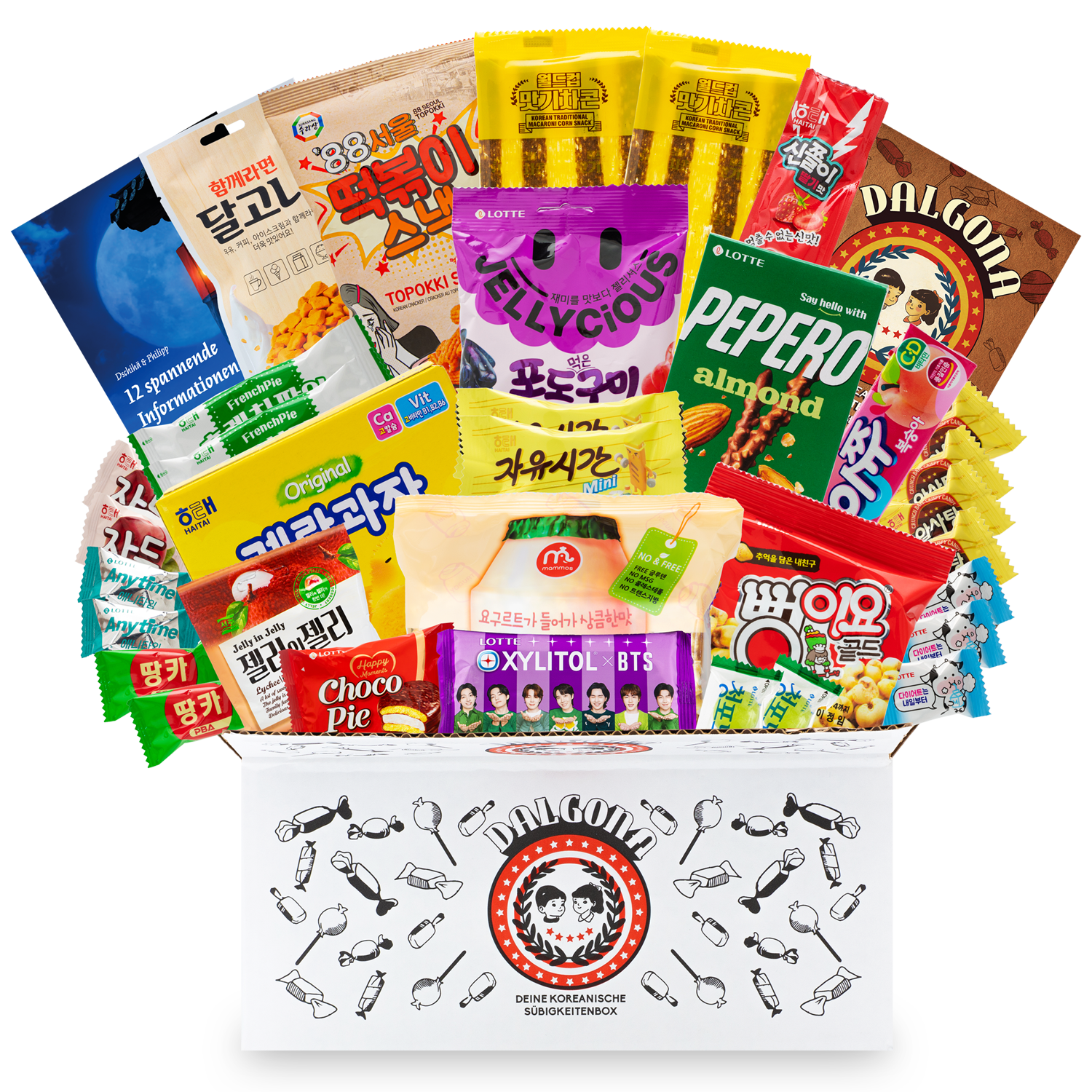
- Samgak gimbap: triangular rice snacks wrapped in plastic film from the convenience store. If you want to try Korean convenience store snacks, you can find them in our Korea Convenience Store experience box.
Most recently, kimbap became famous outside Korea in the United States: in August 2023, the supermarket chain Trader Joe's launched frozen kimbap, which sold out nationwide after about two weeks following a viral TikTok video.
Kimbap or gimbap?
Both spellings mean the same thing. Gimbap follows the Revised Romanization that South Korea introduced in 2000. Kimbap is the older spelling. Trader Joe's, for example, sells its product under that name.
How long does kimbap keep?
Kimbap tastes best on the day it is made. In the fridge, the rice turns hard because the cold draws water out of it. If you want to make it ahead, Seonkyoung Longest recommends wrapping the rolls tightly and leaving them at room temperature for a few hours. For leftovers from the day before, there is a trick in Korea: dip the slices in beaten egg and pan-fry them until golden. This is called 김밥전 (Gimbap-jeon), and the rice turns soft again.
Sesame oil and sesame seeds for kimbap are also included in our Dosirak cooking box with 25 Korean recipes. Another rice dish to make at home is bibimbap.
Sources
- Korean Bapsang: kimbap recipe
- Seonkyoung Longest: kimbap recipe
- 10000recipe: recipe 373365 and gimbap-jeon (in Korean)
- South Korean Ministry of Culture (KOCIS): Evolution of gimbap (2022), Webzine 2024, Webzine 2018
- Korean Food Promotion Institute: article on gimbap
- Korea JoongAng Daily: on gimbap as picnic food (2022)
- Korea Herald: Cheap eats in storied market (2011)
- NBC News: on Trader Joe's kimbap (2023)
- Wikipedia: Gimbap, 김밥, Chungmu-gimbap



Leave a comment
This site is protected by hCaptcha and the hCaptcha Privacy Policy and Terms of Service apply.